Art works are arranged more or less chronologically. By clicking on the forwards buttons (>) images and their captions can be read like a story.
 |
01 Antarctic waves 01 (2002)
Pen and ink on notebook paper. A4 |
 |
02 Ice mirror (2007)
Acrylic and pencil on primed fire paper. 900mm x 1450 mm |
 |
03 Ice turning (2007)
Acrylic and pencil on primed fire paper. 900mm x 1450 mm |
 |
04 Tusalava (Just the same), from Lye (2009)
Pencil on notebook paper. 90 mm x 140 mm |
 |
05 Oil track (2007)
Pencil on notebook paper. 90 mm x 140 mm |
 |
06 Fluoro zooplankton 01 (2006)
Engraved fluorescent Perspex sheets, 130mm x 130mm (x2), Mounted in metal heat sink |
 |
07 Ice archive 01 (2008)
Engraved Perspex disks with acrylic inlay, 50mm diameter (x8). Up-lit with white LED light |
 |
08 Southern Ocean waves warming (2007)
Engraved Perspex with acrylic inlay. 65mm x 120mm (x3) |
 |
09 Sea levels rising 01 (2007)
Found materials: Perspex sheets (x2) Engraved and inlaid with acrylic, mounted with steel thread. 360 X 185 X 30 mm |
 |
10 Cool us cocco (2010)
Recycled glass drink bottle and thermometer. Engraved and inlaid with acrylic. 300mm H x 60mm W x 60mm D. Up-lit with white LED light |
 |
11 Diatom 01 (2009)
Perspex block, engraved. 45mm x 80mm x 20mm. Up-lit with white LED light |
 |
12 Euphausia superba: Antarctic Krill 01 (2009)
Perspex block, engraved and inlaid with acrylic. 45mm x 80mm x 20mm. Up-lit with white LED light |
 |
13 Oceanic minds 01 (2007)
Found materials: Perspex sheets (x4). Engraved and mounted with acrylic thread. 360 X 360 X 60 mm |
 |
14 Spectrum berg 01 (2007)
Found materials: Perspex sheets (x4). Engraved and mounted with acrylic thread. 360 X 360 X 40 mm |
 |
15 Pteropod: Sea butterfly 01 (2007)
Perspex block, engraved and inlaid with acrylic. 45mm x 80mm x 20mm. Up-lit with white LED light |
 |
16 Sounds like bird calls come from the ice (2009)
Perspex block, engraved and inlaid with acrylic. 45mm x 80mm x 20mm. Up-lit with white LED light |
 |
17 Antarctica registers changes (2009)
Found materials: Perspex sheets (x2) Engraved and mounted with metal thread. 130 X 130 X 130 mm. Up-lit with white LED light |
 |
18 Antarctic benthos: sea floor life (2004)
Pencil on A3 notebook paper |
 |
19 Ancient mariner (2004)
Pencil on A3 notebook paper |
 |
20 Ice cores 01 (2004)
Engraved Perspex disks with acrylic inlay. 50mm diameter (x8). Up-lit with white LED light |
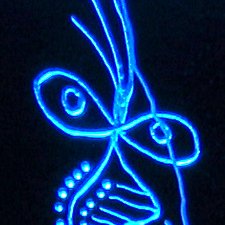 |
21 Core images 01 (2009)
Perspex block, engraved and inlaid with acrylic. 45mm x 80mm x 20mm. Up-lit with white LED light |
 |
22 Core images 02 (2009)
Perspex block, engraved and inlaid with acrylic. 45mm x 80mm x 20mm. Up-lit with white LED light |
 |
23 Milankovitch cycles (2008)
Pencil on notebook paper. 90 mm x 140 mm |
 |
24 Salisbury Plains spiral (2008)
Pencil on notebook paper. 90 mm x 140 mm |
 |
25 Circling dancer (2008)
Pencil on notebook paper. 90 mm x 140 mm |
 |
26 Mapping Antarctica (2007)
Acrylic and oil on primed fire paper. 900mm x 1450 mm |
 |
27 What if Antarctica was in your mind? (2009)
Digital drawing. Variable size |
 |
28 Primate loop (2007)
Pencil on notebook paper. 90 mm x 140 mm |
 |
29 Nothingness (2009)
Digital drawing. Variable size |
 |
30 Antarctica is animated (2009)
Digital drawing. Variable size |